• photo

    Every time I travel I am energized and struck by new possibilities. As the plane begins its descent, I wiggle in my seat and think: I could live here (or there or there). The world brims with sparkling promise, the way ocean waves shimmer and dance all the way to the blurry far off horizon on a blue June day.

    As the plane lands, I feel so full of life. In a flash I understand completely why even tired old horses prance so excitedly on windy fine mornings. They smell change on the wind.

    Suddenly anything seems possible.

    I want to run to the edge of the boundaries—those fences I built or the world erected to contain me.

    And then to push past that, and find the elusive place where I can live beyond old fears. Where I can revel. And completely relax. It could be anywhere. It could be inside me.

    Will people think I’m strange if I prance in this spring wind?

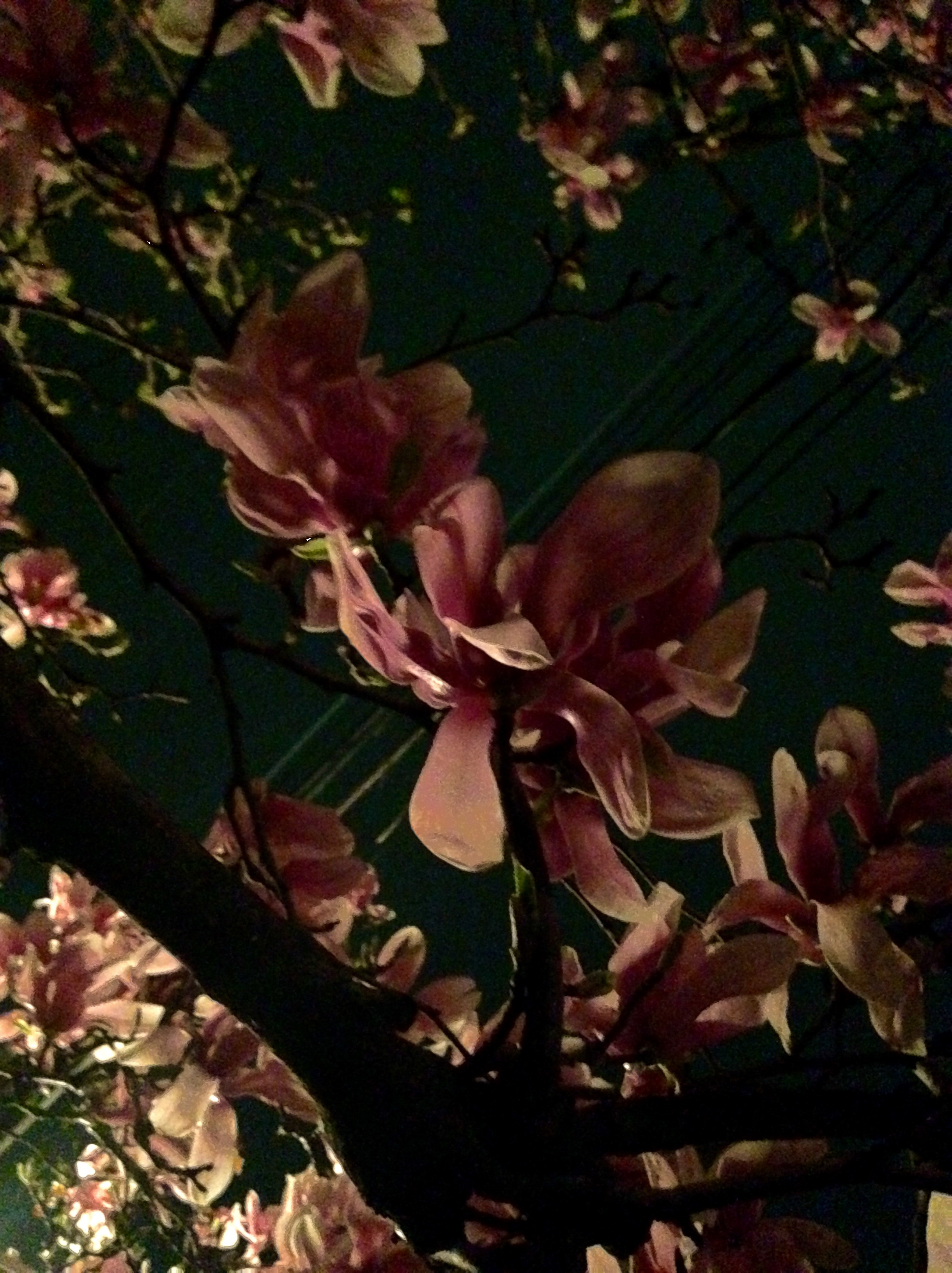
  • prayer for a windswept walk

    To pray you open your whole self
    To sky, to earth, to sun, to moon
    To one whole voice that is you.

    – from “Eagle Poem,” by Joy Harjo

    photo
    Eagle guarding Eden Park
    photo
    Brave buds on a cold day.
    photo
    Ohio River from Eden Park.
  • photo
    Broken?

    Broken or not?

    At snack time or lunch, that was a favorite game of my daughters. One would hold up an apple slice or a Ritz cracker or shiny orange Clementine and demand of the other, “Broken or not?”

    They were both pretty masterful at holding a broken cracker or piece of fruit in such a way as to camouflage its fault lines. They loved to trick each other, and trick me, too. It was so hard to tell.

    Because you cannot always tell if something—or someone—is whole by merely looking, can you?

    I remember in the weeks after my father died suddenly, back when I was eighteen. I’d put on lots of mascara every morning, so that I wouldn’t cry, because if I did, it would give me raccoon eyes. I didn’t want any one to know how badly I was hurting. I didn’t know what to do with it, the pain. If I started crying, I might never stop; how embarrassing that would be. No one ever taught me anything but to pretend to be okay, to deny my real feelings. It ran in the family. Schooled from birth, like Tiger Woods was with golf, I was an ace.

    My dad pretended he was okay right up until he died from it. Oh, it was a heart attack that killed him, but my personal theory is that sometimes illnesses spring from—or are worsened by— the grinding stress of hiding feelings. And we are trained to hide them, for fear of being labeled ‘broken.’ Our culture demands us to be perfect parents, perfect children, perfect wives, perfect workers. To be magically ‘perfectly adjusted’ without working through grief and trauma.

    I used to sometimes reflexively use the phrase, “practice makes perfect,” with my girls, mostly right about when they were supposed to do math homework or play piano or violin. They would always shoot back, “But Mom, you always say that nobody’s perfect!” And I would smile and say, of course, that’s true.

    Because I’d say that, too, all the time—like when I’d drop an egg on newly mopped floor, or especially if one of them did.

    Of the two old sayings, only “nobody’s perfect” rings true.

    The most together-looking people can be the most broken inside. You never really know, unless you get to know someone, unless you earn their trust and confidence, and even then—they have to be open enough or broken enough to expose their hidden wounds.

    Which for some people is painfully hard, or even maybe impossible without help and work.

    I think the true answer to the broken or not question—as it applies to humans, not fruit or crackers— is that we’re all broken at some point, and not all breaks heal completely. Some wounds ache forever. Being gentle with each other is always a good practice. Because more of us are broken, than not.

    photo

  • photo
    McMicken Hall Spire

    That voice

    Sinking into my gut like
    a spire into a low sky
    it walks with me, or used to—
    maybe that’s why I learned to
    walk so fast, shins burning hot
    uphill, it always beat me…
    until I learned not to hear.

  • beech tree
    American Beech, Burnet Woods, March 2015

    Another 7×7 poem (seven lines, seven syllables per line.) This one inspired by endings—of seasons, of eras.

    Marcescence
    Sometimes we hold on too hard;
    cling to what should be released—
    old, winter-worn, transparent
    from time and weather, rattled,
    beaten, tattered— it’s hard to
    let the familiar fall
    away, let new growth emerge

    Note: Marcescence is a botanical term that refers to trees that retain withered leaves over the winter. Beeches and some oaks are among the trees that cling to old dead leaves. Though there are several theories, there doesn’t seem to be agreement on why this happens. One school of thought is that beeches and other marcescent trees are still evolving from evergreen to deciduous, caught forever betwixt and between. (I’ve felt that way sometimes, too.)

  • I haven’t had time to write this week, but I walked in the (last?) snow of the season.

    The sky was flat and bright, like an impossibly bright light table. I forgot my sunglasses and found myself squinting. There was a hush, so quiet, it seemed like a Sunday morning.

    But the birds were singing like it is spring already, and soon it will be.

    photophoto


    photograph

  • photographThis is the first blog post I’ve written straight into the chute without a little polishing. I’m frazzled. I’m moving. I’m selling a house I lived in for almost 2 decades, a house I had a wonderful family life in.

    I’ve been packing up and purging and sorting for months now. And now it’s almost show time. A few weeks ago at Rohs Street, I wrote a fast write about finding dolls in drawers, because that is a thing that keeps happening.

    But because I’m moving and packing and purging, I have no idea where that fast write is. I think there was a good line or two in there, about opening drawers and feeling eyes upon me. Eyes of the past, unblinking, watching me forge ahead into the future.

    It’s hard enough to put all those precious crayoned drawings and lovingly made paintings into the recycling bin (but I did it. Okay: I saved a few. A few hundred…). But the dolls: the dolls are watching me. The dolls make me remember the sound of laughter drifting in from A’s room, where she and her sister and a couple friends were lining up the dolls into a parade. The dolls make me wish I could somehow package up a few boxes of the past to dive into whenever I feel lonely for my girls.

    The past is always with me, in me, part of me. Still, the dolls seem reproachful. Doesn’t she look a little pissed off to you?

    I guess change is always hard. The doll and I will both be okay. We won’t be alone, either. She’s coming with me.

  • photograph
    Wintery mix sunset

    Another 7×7 poem

    February Sunset
    Heater blasting hottest air
    seat warmer radiating—
    knuckles whiten on the wheel
    as Neptune’s tail lashes hard;
    it is three degrees below—
    my heart catches fire watching
    this sunset through driving snow.

  • photograph of computerWorking one day, alone in my tower—er, office—I listened to Loreena McKennett singing “The Lady of Shallot” (lyrics from Tennyson’s poem)  and it struck me how the good Lady and I have more than a few things in common. We even share a first name— she’s based on the Arthurian legend of Elaine.

    Modern technology is often blamed as the cause of our loss of connection with life and each other, but maybe it’s not just computers and phones that distance people from life. The Lady of Shallot had the same problem, really, and ages before Apple Stores appeared on the scene. She stared into a mirror, not a computer, but the mirror was not to blame for her isolation. It was just a symptom.

    I think fear was—and is—the problem.

    Fear of engaging the unknown. Fear of being vulnerable. Fear of the messy realities of life. Fear of feeling scared, or lonely, or even bored. Lady Elaine had a curse that scared her. Modern Elaine has the 6 o’clock news and endless posts and messages screaming that life “out there” is frightening. Thus she, and I, kept busy, kept our noses firmly to grindstones (or keyboards or looms, depending on the century).

    Gazing at life from a safe remove seems less scary. But that safety is an illusion, a lie—isn’t it?

    There is always some danger in living fully. Touching and tasting and experiencing can and often do lead to pain or anger. Yet they also lead to great joy. I used to be so careful to stay safe, like that other Elaine— and my fear snared me. It still does, sometimes. (Often. Old habits die hard!)

    In the poem, the Lady cannot gaze out her window directly because of the curse; she looks instead at life reflected in a mirror, and so:

    She lives with little joy or fear.
    Over the water, running near,
    The sheepbell tinkles in her ear.
    Before her hangs a mirror clear,
    Reflecting tower’d Camelot.
    And as the mazy web she whirls,
    She sees the surly village churls,
    And the red cloaks of market girls
    Pass onward from Shalott.

    This is about living in fear. About watching life but not being all in. About not taking risks.

    Like many women, I was raised from infancy to be cautious, to not risk too much, to avoid showing myself. To not walk alone, or in the dark, to not wear certain clothes. To not call attention to myself. To not venture opinions without testing the waters to be sure the opinion is acceptable. To not laugh too loud or say anything stupid—or too smart, either. In other words, to fade.

    Think about the word “ladylike.” Merriam-webster says it means to be “polite and quiet in a way that has traditionally been considered suited to a woman.” Another listed definition is even more telling: “lacking in strength, force, or virility.”

    The most impregnable towers are those you build yourself, one ladylike brick at a time.

    The Lady of Shallot is the ultimate fear-tale. When the Lady is finally stirred by lust and dares to leave the tower and venture into life, she’s struck stone-cold dead! She floats downstream where her pale, dead beauty is admired but her life is not much mourned. Maybe because her life was so pale and weak and confined, as she’d been taught it should be.

    It’s better to weave by night and day and catch silvery glimpses of life, to keep safe in your tower, to avoid risking strong feelings of any kind. Life represents danger— strong emotions, good or bad, are to be feared.

    “She lives with little joy or fear.”

    Sad, the quelling message of this.

  • photo of leavesI recently heard Pauletta Hansel, a wonderful Cincinnati poet, read some of her work. A series she read introduced me to a form I’d never heard of before: the 7 x 7, also known as a “49-er” by some. The form is simple, 7 syllables per line, 7 lines. I really loved how her 7x7s packed so much in a small package.

    Playing with a very concise form is challenging. I’ve started a series using scientific words that I have been collecting for a while in my interesting-word junk drawer. (I knew I’d find a use for them.)
    Here’s one:

    phototropism

    there’s a word for everything
    that one means “grow toward light”
    plants tend to keep life simple—
    born with a mission, they sprout,
    burst from their seeds knowing how
    they might blossom, but not why—
    no questions asked, they just grow