• September 23, 2014 / Haiku exercise

    Haiku #1

    River curves away
    Blue sky sweeps above, cloudless
    iphone memory

    I am trying not to feel like I have to pin beauty down, like a butterfly to a board. But I can’t seem to stop.

    Another haiku?

    Haiku #2

    Captured river, caught
    Pinned down, like a butterfly
    iphone memory

    I’m thinking so much lately about what is precious, and how scraps of precious things live in my phone, collected there like when Hermione Granger charmed her beaded bottomless bag in the last Harry Potter book, so it could hold everything that was essential to battle Lord Voldemort: a tent the size of a house, books, food, clothes to take the chill off, life-saving medical supplies, anything she needed to move the story ahead—what magic, that story.

    Magic like iphones are magic, in their way. My iphone: I resisted getting one for so long, after reading in horror about the Chinese workers who made them—probably still make them, who am I and Apple’s PR machine kidding? The workers housed in gray dormitories in smoggy cities where poison air stings throats and eyes, workers—flesh and blood people—harnessed like plow horses to relentless time clocks.

    Down another time-ladder, I slip to another century, another magical book, Little Women—the March sisters and Marmee refusing to wear silk dresses because of the child labor that went into making them. No, the March women wore plain Poplin, unfashionable, virtuous. Except for Amy. Selfish, vain Amy — and guess what? I’ve become Amy, haven’t I?

    To assuage my guilt, I use my iphone to collect tiny bits of the world, to fashion a beautiful mosaic of songs I love, of my two daughter’s text messages, of hundreds of photos snapped when the light! THE LIGHT! Stuns me, as if maybe I might someday be trapped in a windowless dormitory, a joyless world where my pictures of nature and cryptic messages from the past will be the only things that sustain me?

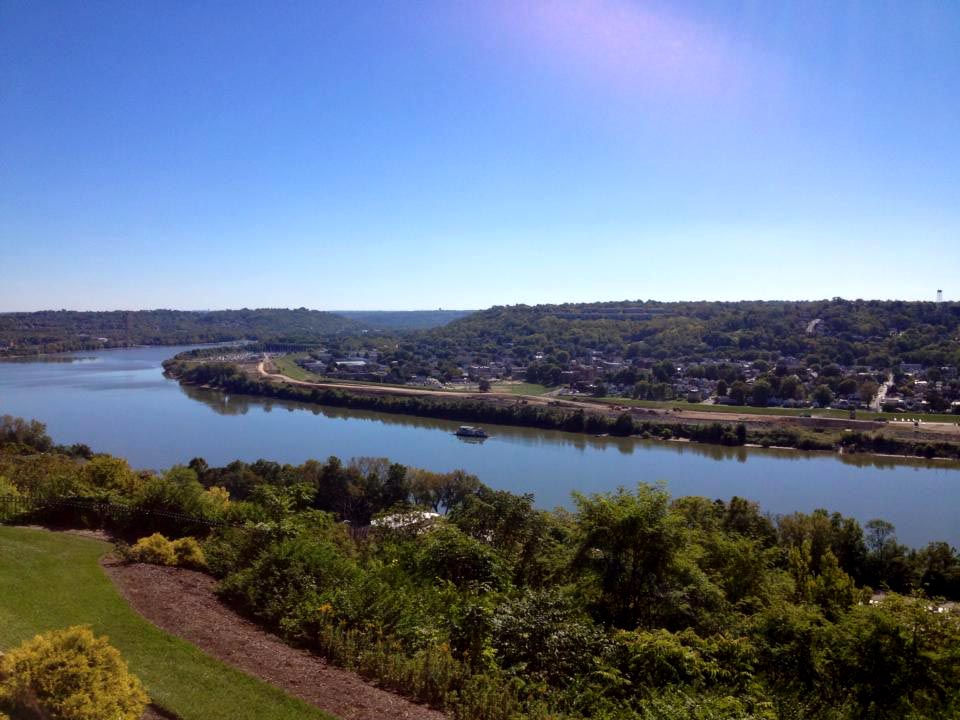
    Maybe that’s the fear. That if I don’t somehow bottle it, it will all vanish? Is that why I’ve recorded the songs of crickets and cicadas? So in some deep cold winter moment, I can hear summer again? All those notes I make, poem fragments and angry rants and ideas and books I should read, want to read, all the flotsam and jetsam of life flowing past like the mighty Ohio did this morning, when I captured it in my iphone. Snap!

    Pinning it all down, like a butterfly, pinned. A picture Lydia texted me, of her, smiling, hugging that pretty Border Collie in her college apartment, if I save it there, and look at her smile, will that keep her smiling, always?

    I pour over my collection sometimes, find beauty, pain, insights and treasure: those notes I when I wake and can’t find my journal, tip-tip-typing instead of scrawling, frantically recording those recurring dreams of ice and glaciers and endless winters, mixed in with sunshiny sunflowers in a vacant lot.

    It’s all in there.

    Ohio River photo
    Ohio River, September 23, 2014
  • cicadaCicadas

    Their maracas shake in dark trees: even indoors, windows closed, fans on:
    they thrum, thrum, a constant presence, insect-induced tinnitus
    I like their cascading drone, insistent announcement—we live!
    Humans, greedier than any insect, haven’t killed them off, not yet,
    unlike the passenger pigeons, once so plentiful
    flocks of them darkened the daytime skies for hours
    went from most populous bird on the planet
    to extinct in a century, a blink of time.
    Martha, last survivor, died alone in captivity
    a hundred years ago last Monday
    just  a stroll from my house,
    in a cage at the
    Cincinnati Zoo—
    it’s still there
    on display
    empty.


    -September 3, 2014

  • This is very belated, but I’m thankful and honored for the mention over at michaelalexanderchaney.com! Great site, packed with literary advice and reviews. Check out this post for flash publication ideas.

    Michael Chaney's avatarmichaelalexanderchaney

    Slide1

    The flash markets on this list include the best around. They’re not impossible to break into. Not as much as say, Willow Springs, whose editor informed us recently here on this blog that only one out of a thousand pieces gets picked for publication from the slush pile. One out of a thousand! That’s roughly the same odds as Bono being the next pope, of sneezing with your eyes open, or [ gulp ] of asteroid 1999 RQ36 smashing into Earth.

    While these magazines are not so apocalyptically stingy with their acceptance, they’re still selective (and I’ve got an asteroid belt of rejections from them in my in-box to prove it).

    You might think of this list as as continuation of an earlier post on the very best, since these magazines are more challenging to break into than those on the other two lists I’ve compiled: Top 10…

    View original post 2,540 more words

  • deer in yard


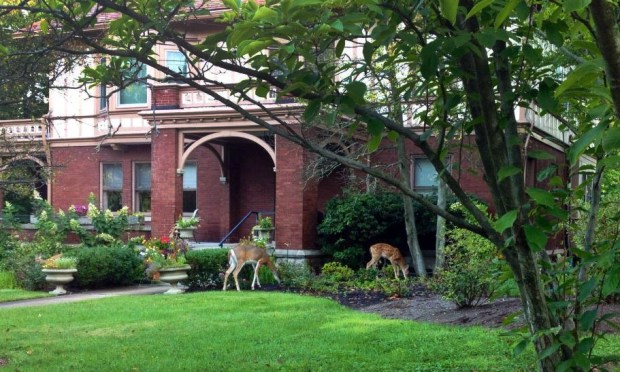
    Yesterday morning at seven-thirty, I went for a walk. The sun was streaming down Evanswood, turning the street into a golden river of light. Across that river, in the neighbor’s front yard, a trio of deer placidly munched hostas, unbothered by the dog walkers and the pack of school children milling at the bus stop at the corner.

    I snapped an iPhone shot of the deer, a slender chesnut doe, and her twin fawns, still wearing their star-speckled coats. I felt sad and happy all at once.

    I love deer. As a child, I obsessively drew pictures of deer. Bambi was my favorite book. Deer were shy and quiet, like I was, yet they were also swift and mysterious and tapered. I still think they are the most elegant creatures, with their long legs and big dark eyes—the Audrey Hepburns of the animal kingdom.

    Yet standing there, watching them devour what was left of the Shapiro’s lilies, I felt sad, too. Because seeing deer in the neighborhood is no longer a novelty. They are everywhere. Their numbers are growing and there’s nowhere for them to go.

    My gardening friends mourn the loss of their hostas, and I get that. But: the deer. They have nowhere to go, and whose fault is that, exactly?

    A couple hours later, I drove off on an errand.

    At the intersection of Martin Luther King and Central Parkway, a young woman stood, holding a sign that read “hungry & homeless.” She was tall, thin, sun-browned, her face already a little leathery though she couldn’t have been much past thirty. I thought of that famous photo, you know the one I mean? That one of the sad-eyed depression-era migrant mother, her face a map of her worries?

    I’m famous for never having cash on me, but earlier I’d found a ten dollar bill while loading the washer, and I’d shoved it in my pocket, feeling pleased.

    I looked at her, motioned, rolled the passenger window down.

    “Thank you,” she said, taking the crumpled bill. And then, as she realized it was a ten and not just a dollar, her whole face lit up. “Bless you,” she said, joy transforming her face, stripping away years, until I could imagine her in high school, dreaming of her future.

    Maybe she’ll drink it or shoot it up or something. Or maybe she’ll get to eat a good meal. Not my call. One thing I know for sure, she didn’t grow up dreaming she’d be standing in the hot September sun next to an interstate and a White Castle, begging.

    There are so many in this world, with nowhere to go.

    I drove away, wishing I’d found a twenty, or maybe two twenties, folded carelessly together and left in the pocket of my walking shorts. That happens sometimes, when you have as much as I do. I wondered if I’d have handed it over, had it been twenty dollars, or forty, and I hoped that I would have.

  • ghost-ranch-pedernalIf you’re from the Midwest, it’s hard to imagine the colors at Ghost Ranch. Even if you’ve seen Georgia O’Keefe’s paintings and dozens of beautiful photographs.

    My Ohio home, lush as it is, looks faded in comparison, dully monochromatic. I feel like I’ve been colorblind until now, and am suddenly cured. New Mexico is red-orange and bright sienna and a million greens— dark pine, gray sage, springy alfalfa and the soft green cottonwood clouds seaming the arroyo behind Staff House and the dining hall.

    And blues: robin’s egg morning skies that burst into turquoise afternoons that deepen to cobalt above far-off mountains that range from wet denim to teal to slate. Blues so deep you want to dive in and float. Blues that make me forget for a moment my love of oceans.

    Perched on the Welcome Center porch, I have a clear view of Pedernal, the mountain Georgia O’Keefe claimed from God for her very own.

    Cerro Pedernal is his full name —I’ve decided this mountain must be male— which in Spanish means Flint Hill. Like everything here, Pedernal changes by the hour, but right now he is crowned with clouds and scrimmed by rain, a looming, watery, flat-topped shadow in the near distance.

    Closer in, the sandstone and gypsum cliffs form a backdrop to kids on bikes and the changing kaleidoscope of residents and workers that zigzag between the buildings. The cliffs are a multi-toned tapestry of gold, peach and terracotta red dotted with dark juniper knots and etched with shadows forming a thousand faces.

    There are spirits here, in the shadowy mountains and cliffs. I feel them, silently watching those of us who come and go, seducing people like me from flatter, grayer places.

  • ghostranch-cliffs


    “It is all very beautiful and magical here–a quality which cannot be described. You have to live it and breathe it, let the sun bake it into you. The skies and land are so enormous, and the detail so precise and exquisite that wherever you are you are isolated in a glowing world between the macro and micro, where everything is sidewise under you and over you, and the clocks stopped long ago.”
    Ansel Adams, describing Ghost Ranch, in a letter to Alfred Steiglitz ,1937


  • photo
    thunderhead in SUV window
    photo
    Another angle
    photo
    Terrace Avenue at dusk
  • The universal donor develops a taste for blood

    What if
    I closed my eyes right now, accelerated hard
    Just waited for the impact, the pain,
    the wailing sirens
    “She lost control on the Norwood Lateral,” they’d say.
    “Nearly bled to death.”

    Or what if
    I lost control, of myself,
    In produce between the melons and the salad bar,
    when that lady in tight capris slaps her sobbing toddler
    “She BIT that woman at Kroger’s,” they’d say.
    “She drew blood!”

    And what if
    I developed a taste for blood, began to crave more
    To seek angry people, timid children, laughing babies
    Napes exposed, tender, pink with longing, with pain, with joy
    “Is she all right?” they’d wonder,
    then cross the street to avoid me.

    And what if
    I ran away, left life and laundry piled up behind?
    If I loitered in all-night diners
    sipping bitter black coffee, eavesdropping
    “What’s with the notebook,” the waitresses would whisper.
    “She writes all night long. Weird.”

    And what if
    I drank in what I needed, instead of giving it all away?
    If I grew fat and full and flush
    cut my heart open and let it all spill warm, red and alive
    onto blue-lined paper
    into stories pulsing with life?

    2006/rev2014

  • green-cloudsSo excited–my newest sci-fi short story, The Cloud, was selected for inclusion in the June issue of Black Denim Lit. Read it and let me know what you think! Thanks to my workshop and Avery for reading early drafts; your comments were so helpful.
    http://www.bdlit.com/the-cloud.html

  • I’m just back from an amazing week in Bloomington, Indiana, where I attended the IU Writer’s Conference—for anyone considering this conference in the future, I’d highly recommend it. Come well-rested—you’ll be too inspired to sleep much.

    Teachers included the amazing Jim Elledge, who just won a Lambda award for creative non-fiction; Christine Sneed, inspiring master of voice and craft; Mike McNally, who wove insightful philosophy into his fiction-writing lectures; and Stephen Motika, poet and equal-opportunity nurturer of both reluctant and enthusiastic poets.

    I wrote a series of three sonnets (or sort-of sonnets, anyway) in Motika’s class. I really enjoyed the process. I think of them like sketches. Here they are:

    Rising
    (June 3, 2014)

    Hot met cool, see the hawk glide? Watch, I said,
    buying time, fighting to keep you earthbound
    spinning sad stories of morning skies red,
    of lost planes, never found, of ships run aground
    Pink spells disaster, I hiss, desperate
    Too late—you have flown, left me here alone
    in the parking lot, forlorn, disparate
    Left, as you thread through clouds as gray as stones
    On the blood-red hood of your car, I brace;
    I cannot follow where you fly, slice, skive

    Spinning out, shrinking to a speck, I trace
    your spiral path, praying: Don’t. Don’t dive.

    *this was supposed to be a traditional sonnet: 14 lines, iambic, etc. It fails on many counts, the biggest being that I cannot count! It’s 12 lines (oops). This is what happens at 1 a.m. But it was fun anyway.


    Mustard Seed
    (June 4, 2014)

    It’s gone, fragment of my Episcopal childhood
    tiny speck of faith lost in my jewelry box.
    Faith, you tell me, sprouts from this tiny seed,
    branches spreading wide, high
    sheltering all the birds of the sky
    I have to find it, untangle the chain, believe
    That mustard seed is all I need, you say.
    I want to believe, as you do,
    though your world’s aflame,
    Trusting that God has you, safe in his palm
    What is to burn bright, what is to give light
    Must endure the fire, survive the burning:

    Can you? Please, I need to find my mustard seed.
    I want so badly to believe.

    *Notes: for this sonnet, we were to loosen the definition of sonnet; although there are some rhymes, I didn’t focus on that. There are fourteen lines, and a ‘turn’ at the end. “what is to give light must endure burning” is a quote from Holocaust survivor Viktor Frankl, one of my favorites, and I borrowed from that towards the end.


    Faith
    (June 5, 2014)

    I have faith in the way a wasp nest is never quiet
    I don’t want to cause problems at this stage
    I cannot follow where you fly, slice, skive
    over goldengrove unleaving
    spinning sad stories of morning skies red
    sheltering all the birds of the sky—
    she may entangle in that golden snare;
    Faith, you tell me, sprouts from this tiny seed,
    with near-instant results (including wealth beyond your wildest dreams).
    Chronic irony is an arthritis of the spirit:
    I’m in the parking lot, forlorn, disparate
    I have to find it, untangle the chain, believe

    My faith flies in angry circles round my head
    Go! Spiral, soar, sweep the wide sky, like a hawk


    *note: this is a collage sonnet, composed of lines from the sonnets of I wrote in class, as well as from poems by Gerard Manley Hopkins, Amoretti Edmund Spenser and Aimee Nezhukumatathil, a new couplet by me, and three random lines—from a tweet by Joyce Carol Oates, a client email, and a junk email advertising chakra healing for only $39.95.