Name a fear you have. Breathe again. Now, write about where it lives in your body. 10 minutes, go:
My fear is not being understood by the people I love.
This fear lives in the dungeon of my throat. It is the murky water at the bottom of a bottomless well. There is no light here, and so I have to imagine how it looks: like a midnight mirror on a starless forever after. Nothing shines back at me, there are no glimmers of recognition, no waves of love, only swells of anger, churning the black water.
There are military ships crisscrossing the water, painted with lead-based gunmetal gray, their decks studded with heavy guns and heat-seeking missiles in evil-looking launchers.
My fear holds me hostage below decks on the largest of the battleships. I’m in a metal-caged brig in the deepest hold. The light is yellow and blurry and the air tastes stale.
A row of judges sit, dark-robed, heavy browed, convicting me of the crime of being myself. The primary judge is a white-wigged woman with a sharp nose. She addresses me, in a bored tone. “How could you expect to be understood,” she asks rhetorically. “You are not understandable, not acceptable.” She looks at me as if I’m a used tissue someone has dropped. She shakes her head in disgust. “Not understandable,” she repeats.
Like the queen in Alice in Wonderland, she only wants me to lose: my head, my heart, my voice, my confidence. But most especially, my heart.
My heart lies beneath this dark sea, at the bottom of the bottomlessness of this well in the dungeon of my throat. In my panic at being alone and not understood, I’d forgotten where I was. Here, in my body. I remember suddenly to breathe in, and when I do, I turn my gaze away from the judges. I listen to my steady inhale instead of their scornful murmurs. And I hear it. My heart. It is beating, far, far below the prison ship.
Steady dear heart. The dark water glows green. I know this even with my eyes closed, even in the prison of my fears, even as the judges cough and scritchy-scratch their pens across banishment decrees.
My heart swells, filling me with hope. A rising tide lifts all boats, even heart-sinking gunmetal battleships. The fleet of war ships circling my throat dissolves like sugar candy in the warmth welling up.
I think I’m ready to go deeper.
_____
I think about fear a lot. I read about it, too. Fear can literally get stuck in your body. Fear tends to incubate rather than dissipate over time, according to Joseph Le Doux, researcher/expert on the amygdala. Naming your fears and feeling them in your body can help you move past fear.
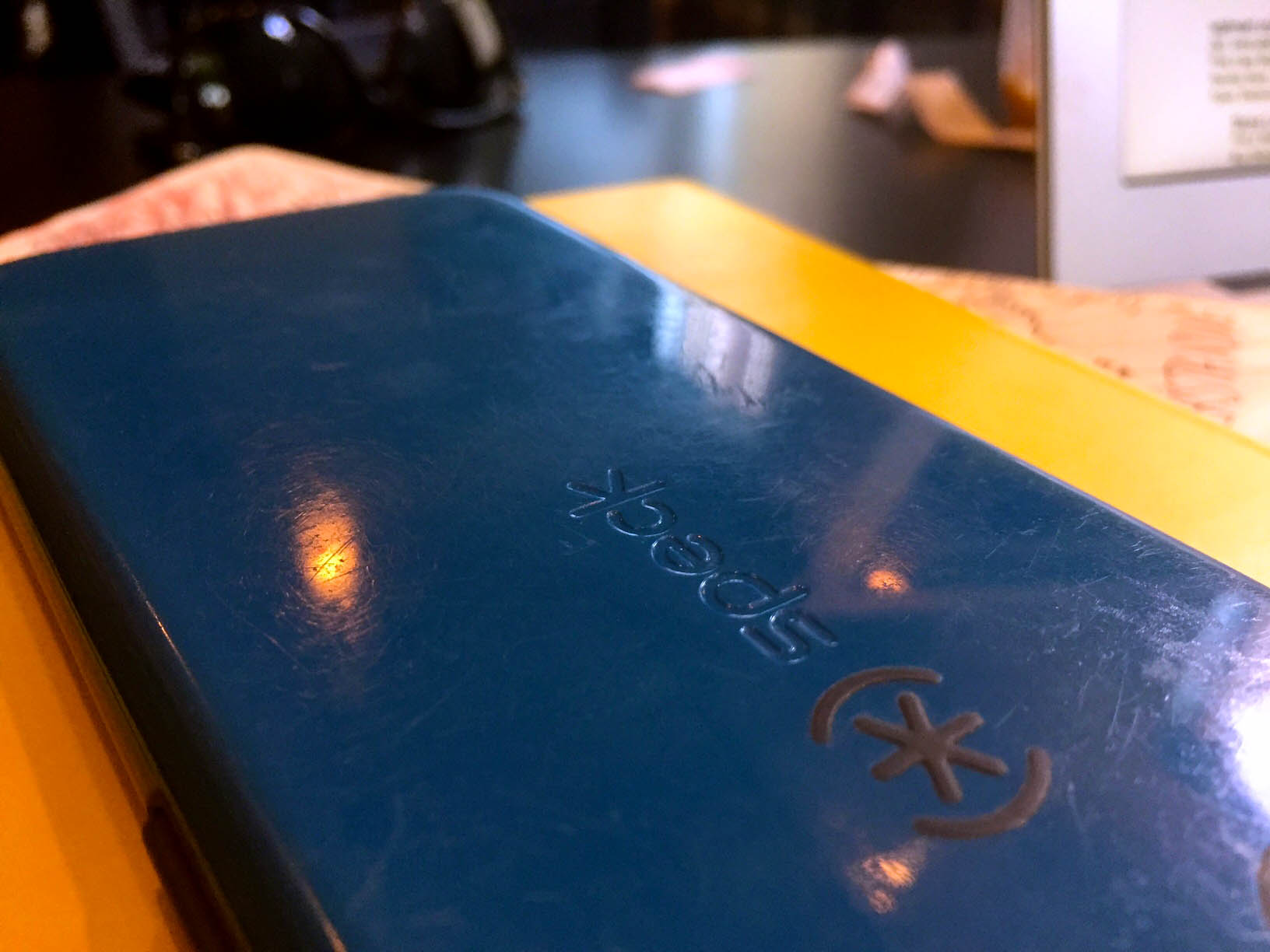
My phone case is shiny plastic, scarred now from use. It is the color of a cartoon character’s eyes, the mischievous female sidekick with a heart of gold’s eyes, eyes that sparkle and pop out from the screen a bright teal-y blue not found in nature.
The edges surrounding the black glass face of the phone are a matte-rubbery black, shaped like the buffering edges of the old Carrom pool table in the basement growing up. It’s a sturdy enough case, chosen entirely because it was on sale at Meijers and I did not want to wait for one to come via Amazon. I just bought what was on sale, in an okay color I didn’t hate, so I could stop worrying about dropping it.
I didn’t notice that on the back, in raised black emboss, the phone case sports a logo composed of a black asterisk set within the hug of two parenthesis.
I think of Kurt Vonnegut, in his novel Galapagos, where he told readers up front he was going to kill off a lot of people in the story, and to lessen the shock, he would add an asterisk before the character’s name in the chapter preceding their untimely demise.
Vonnegut had a thing about asterisks. In Breakfast of Champions, he includes an illustration of an asterisk and explains it is a drawing of his asshole. Or an asshole, anyway. I don’t quite remember the specifics, just that, ever after, I cannot look at an asterisk without thinking of a puckered anus.
I think of this every damn time I drive past a Walmart.
I imagine a group of designers coming up with the 205th round of logos.
One of the designer is maybe was a big reader.
Maybe she threw in the asterisk, as a joke.
This is how things go. You’re joking, and they take you seriously.
You are serious and they think you are joking.
I think of the little towns, in Michigan, Ohio, Indiana, all across the country, hollowing out in their pretty centers, ringed with ugly box stores that you cannot walk to without risking your life.
I wonder if anyone’s ever watched me talking on my phone and thought, “Oh hey! Asshole!”
I wonder if I will ever be able to think of asterisks as I did as a girl, when I read in a book I can no longer summon to memory that aster means star, and that makes me think of skies and night air and falling in love and not finding the book you were looking for, but finding something else entirely.
Of driving as the sun sets and the stars come out, but you are driving too fast to see them until you stop like you did last night, and open the back door for the cat. The house is pitch dark and the sky is covered with stars and the nearer glows of the fireflies.
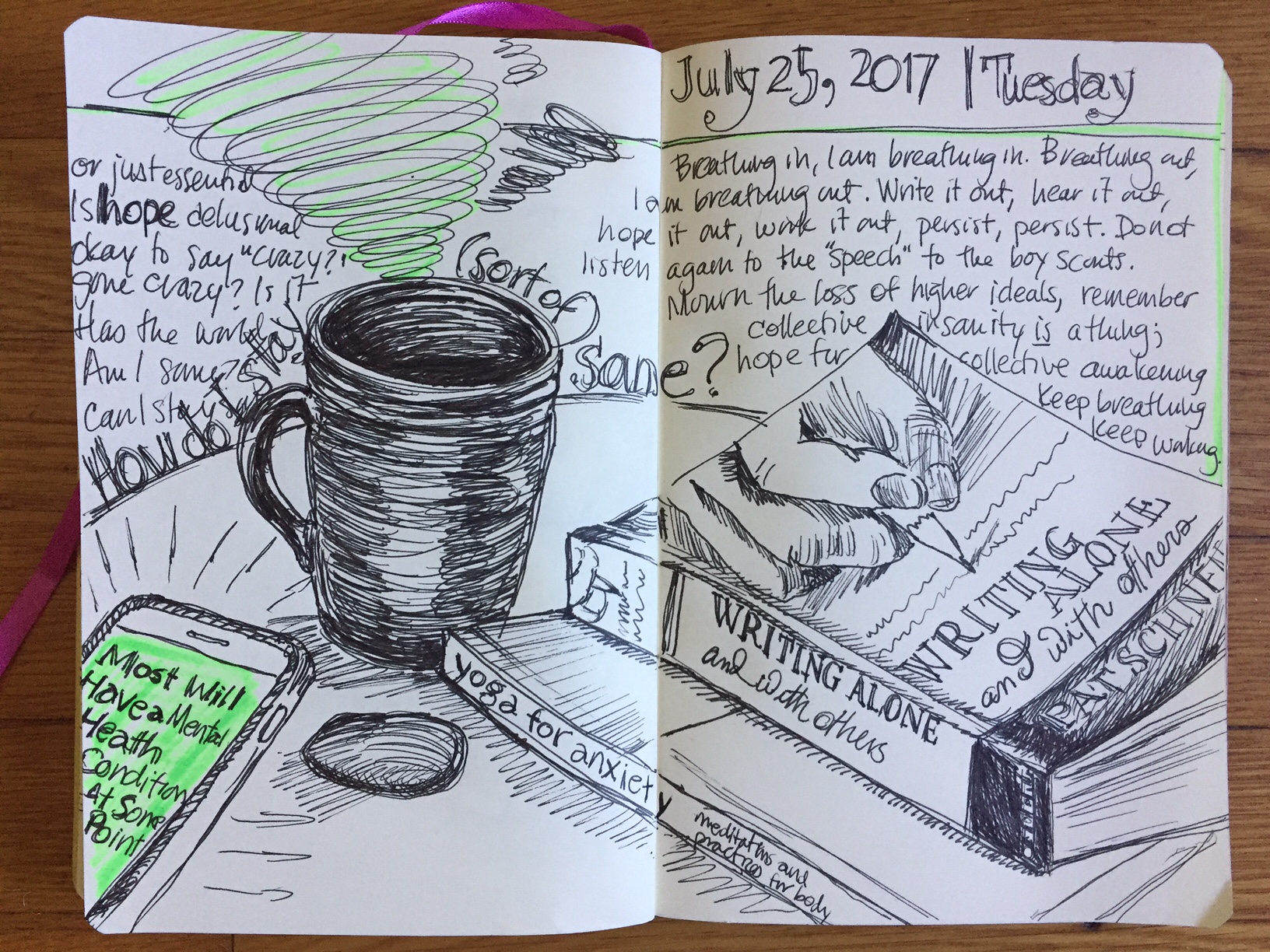
Note: this was a fast write from a prompt in Pat Schneider’s “Writing Alone and With Others,” in which she suggests that if you find yourself blocked, to stop trying to write that novel or poem or whatever it is that won’t come, and instead, choose an object and begin describing it. You can jump from one object to another. What is important is that you choose something concrete, and just go! See what comes up. I picked my phone case and was surprised at where it went and what it brought up. It was fun. I forgot to worry about my novel which isn’t going anywhere!
It’s been twenty-five years since my mom died. Of course I always wished I had been able to compare notes on motherhood with her (she died just weeks after my firstborn came into the world). But now what strikes me is how much I’d like to be able to talk with her about roles. About how they define you and sometimes trap you, and how you must grow past them. And why that seems so hard!
I want to know how she grew past her roles of wife and daily-mom and daughter, all in a few short years. How dizzying that must have been. I wouldn’t know, because for the most part, she didn’t tell me. Always said she was “fine,” and diverted conversation back to me, and my life. And then, suddenly, she was sick. I’ve learned not to wait on having conversations with people I care about. Or at least, I’d like to say I try to do that. I don’t always succeed. It can hurt, for one thing, and what is more human than avoiding pain? Plus I still get trapped in roles.
(And where exactly does a role end and a boundary begin, anyway? Life is so tricky.)
I’m no one’s daughter, no one’s daily-mom, no one’s wife, no one’s most-beloved. I’m just: me. Of course I still play roles—writing coach, yoga teacher, design consultant—but those roles are not cemented to relationships with specific and dear people. They are more like the roles in a play, I suppose.
A couple weeks ago, I saw a live-theater performance of the Hunchback of Notre Dame in Indianapolis, and spent the night afterwards with extended (and very dear) family. The next morning was unseasonably cool. I snuggled up on their deck and thought about the play. The day was bright with birdsong and the chatter of neighbor children. I couldn’t make out what the children were saying, exactly, but it was clear as the blue sky above that they were working out the rules of a game.
YOU will be THIS, I will be THAT.
We don our costumes early in life. Even after we grow into adults, we are, inside, run by the rules of childhood. By the labels we and others stamp on ourselves. The artistic one, the troublemaker, the bully, the little mother, the Daddy’s girl. On and on. Some of us shake them off for who we are meant to be. Others bloom into their labels, and transcend them. And I would once have denied the past ran me at all.
In the dark theater, I watched Quasimodo sing his pain and longing. Watched him be labeled at birth as monster. I think we are all “half-formed,” and destined to stay that way, unless we unearth the past and question it a little. I was the baby, the cry baby, the gullible one, the artist, the poet, the one you could trick and tease and scare easily. The one who would finally, inevitably, cry. And be told, again and again, that my tears were wrong, I was wrong, I was “too sensitive.” I learned it better not to ask for understanding; that I was making something out of nothing. I could not be trusted, and so I did not trust myself, or what I felt or even reality. It was all my artist’s imagination, my poet’s drama. Better not to cry, or, if I did cry, better not to say why. I was the unstable one, the emotional one. My mother, at her wit’s end, used to threaten, “I’m gonna give you to the trash man, if you don’t hush up.”
Now, my mother was not a monster. No, she was flesh and blood and bone and beautiful. She folded me in hugs I still feel. She was human, and struggling. I love her with all my heart. Still, she could not handle my tears, which, looking back, I think may have mainly, early on, belonged to HER, tears she could not cry lest she never stop. Mothers of four have no time to cry.
I can see her, hands on hips, pointing out the window at the trash truck, I remember her saying it—and not just once—forgetting or not caring (I think forgetting) that a little girl who still believes in Santa Claus and the Easter Bunny would never question that the trash men could take her away. I was terrified that the dark men with menacing white smiles and sooty coveralls were indeed going to lift me up like I was a clangy garbage can and roar me away in that smelly loud truck, and I’d never see my Mama again.
And so crying began to terrify me. But tears bubbled and burst out periodically. (Still do). It’s how I’m made.
Recently I had a revelation. A friend was laughing about how she thought of crying as an “emotional enema,” because she always felt so much better once all the tears came out; she felt clean and light, ready to face life again. Until the next time. Sometimes, she said, you just need a good cry. But right then it stuck me.
Crying always—with a few notable exceptions—made me feel worse. The tears bring up shame, brackish and foul, from the dark channels of early childhood. From roles I am still acting out, unconsciously?
The half-formed girl—Quasimodo girl—keeper of secrets in the attic, sleeping terrified clutching a crucifix, the voiceless one, the broken one, the trash-can girl—all my past roles lurked in the recesses of my grown self. They burrowed in deep, and curled hidden inside me for decades, only coming out at the most stressful times, sleeping and waking restlessly, pulling my strings.
On a sunny morning in Indiana, thinking about the past, memories of marriage and motherhood surged in this place of some of the best days of both those roles. Stretched out with my journal, watching the bees buzz in their hives, I felt a new me emerging, ready to really listen at last to all the hushed-up stories of trash girl’s pain, ready to watch it flame up and burn off and billow like the charcoal smoke rising up from the barbecue.
For this moment on this deck in this place, I felt at home with myself. Home is now, I thought. That is the feeling. Of being home in your body. I learned that term from a friend who held me while the hardest pieces of my childhood surfaced, jaggy, tearing me open. Held safe, I learned I could cry and feel better, instead of worse.
Now I am learning to do that alone, as I sort and grow. I’m learning to cry and sometimes actually feel better, lighter, clearer.
Quasimodo no more, maybe?
“What is ‘whole’ in Latin,” I asked my brother-in-law, who had come out to put brisket on the barbecue.
“Plenus?” he ventured.
Plenusmodo. Full-formed. Whole.
Mom knew Latin. I wish I could call Mom now and talk. About the roles she was saddled with by her childhood, about the things she locked away. About why she hid her tears and pain and struggles. Maybe we could let go of our roles, drop our masks, and just listen to each other? That’s all anyone really wants, I think.
To be seen beyond their roles in life. To be held, and heard, and loved for who they are, at the beating heart of their being.
(after Ocean Vuong/after Frank O’Hara/after Roger Reeves)
Someday I’ll smile every time
I bump into myself.
Even when that self is a mess,
an ooze, tears and unwashed hair
undone tasks
and hiccups
and wrinkles
and regrets that smell like
Marlboro Lights and malt liquor
And I’ll smile even when that self has
a pulsing nose zit and writes terrible poems
— I mean, why not? —
might as well plan for the worst-case.
That someday is
seemingly so near and
sometimes so far
like a wet glimmer always ahead on the highway
an illusion of cool
place I can dive into
emerge from
dripping wet and laughing
it’s like that
I find myself and lose myself and find myself
again and again
in the stomach-churn backseat of the hot station wagon
sweaty and skinned-knees
watching mirages
appear and disappear as Pennsylvania miles
turn to New York miles
turn to Massachusetts miles
hot sun turns to clouds and clouds
turn to rain
And someday, Elaine, I’ll love the sound of your name
the way I love the sound of the rain
Someday I’ll love even your inconvenient needs
the ones that turn green and churn when interstate
turns to twisty backroads, dark night
father lost
you have to pee
not yet Mama says
in a little while
Mama says
Someday I’ll love you — you used to be called something else,
remember? Lainey the baby who couldn’t wait
Lainey peeing on the side of the road,
Mama blocking
passing headlamps,
hot urine a glowing stream
the one who can’t wait
the one needing
something embarrassing
needing
Someday Lainey will reappear
dressed for Halloween in the body of a middle-aged woman
(someday she’ll have to grow up, won’t she?)
— even though oh, she needs
still, even now, she needs and needs — damn it
And someday
at the very next exit or 268 miles ahead —
some sweet day that will maybe smell just like the bread my mother
took to baking when she was widowed, just for herself,
just because she wanted to
That someday
I will rise up, a miracle, like the punched-down dough
swelling up in a bowl in an avocado-green long-lost kitchen
I will be full, I will be home
That someday
I will look at myself and melt
melt like butter on
chewy warm grainy bread, fresh from the oven
I will love every last crumb of myself.
Notes: I’ve been thinking about self-love a lot, how hard it is. How essential and impossible in moments (which is why we need our friends).
I really am drawn to Ocean Vuong’s amazing work.
My piece (not really a poem yet, maybe someday?) is from a fast-write from a prompt based on Ocean Vuong’s “Someday I’ll Love Ocean Vuong” — a poem he notes is “after Frank O’Hara and after Roger Reeves”… which made me curious and google revealed Roger Reeves’ intro to his poem: We can’t stay in poetry world forever. It’s a poem that I kind of wrote to myself. It’s a love poem, again. I read this poem for my MFA compatriots struggling in the muck of all types of criticism and self-doubt. It doesn’t stop. It will keep going. No, actually I was struggling in my MFA a lot. I don’t know if you guys are the type of poets that are trying to write poems that last beyond your life, which is what I’m always trying to do. I’m always trying to make something that can outlast me, because why else would we make something? Frank O’Hara is a guy I always turn to. He had this one line in his poem — I can’t find the poem again because you know Frank O’Hara has a lot of poems — and it’s a poem where he says “someday I’ll love Frank O’Hara.” I thought, that is the best thing to say in the middle of a poem — someday you’ll love yourself. So I said, I’m going to title a poem “Someday I’ll love Roger Reeves.”
Try it yourself — read Vuong’s poem and then take a deep slow breath and write for 10 minutes beginning with “Someday I’ll love (your name here)” …see what happens.
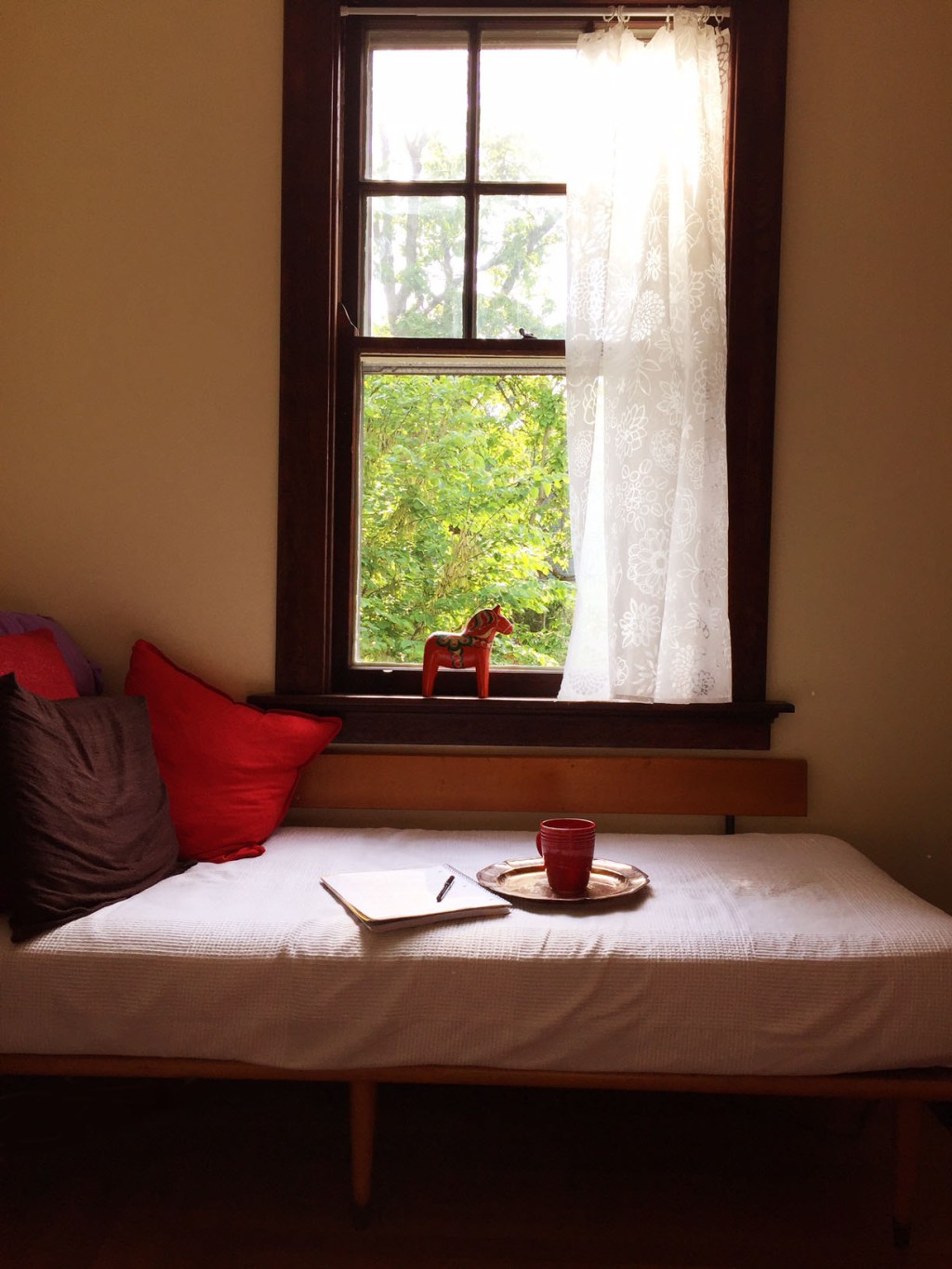
pillows play on the daybed
housecat swishes her tail
radio paints music chocolate-dark delicious as my espresso
the Swedish horse with the broken leg assesses my mental state
the coffee cup outlines the circle of its base onto the table
my sandals inscribe lines on my feet, a loose sundress erases my figure
my journal sketches my thoughts, lines, lines, line
I fade from the scene
I am just inscribed lines
the gel pen observes the work like a skinny foreman,
rigid, impatient at the pace
dear old patient threadbare linen napkin blots up the drips of minty water
life is messy, observes the old Swedish horse
my gel pen climbs down into
the deep hole with me
helps me dig
————
Notes: this is from a Natalie Goldberg prompt in her wonderful book, Writing Down the Bones;
1. write 10 nouns as a list. (I wrote ten things I could see/hear in the room)
2. write ten active verbs (she suggests thinking of verb relating to an occupation; I used “artist” as the verb-source)—sketches, inscribes, erases, observes, blots, outlines, paints, plays, swishes, deckles…
3. combine the nouns with the verbs and see what emerges
Have fun, see what happens. Why not?
It’s high time. I have to have a talk with my Self.
I jump right in. It’s going to be awkward, what I have to say. And Self can be very—fragile and defensive. No sense in beating around the bush.
“Self,” I begin (because it’s always good to call people by name, to personalize it, right?) “You are so not perfect. Face it: you’re just human. You make lots of mistakes. You can’t do it all. You will never be perfect,” I repeat the not-perfect part for emphasis, to be sure she’s getting it. “Just relax, Self. Good enough is good enough.”
Self answers, in her most icy annoyed tone: “I never SAID I was trying to be perfect!”
“Then why,” I ask. “Why are you so impossibly hard on yourself when you fall short? When you say the wrong thing, for instance. When you can’t get it all done. Or when your writing isn’t quite—on the mark?”
Self thinks hard.
Self remembers something a friend showed her the other day.
Underlined in a book she doesn’t even know the title of (can you believe she can’t remember?) she read the words of some learned wise person who said that perfectionism is a form of egoism. That it springs from thinking you’re so good you have to do better, be better, be—perfect. And that it’s actually quite generous and healthy and more productive in the end to allow yourself to be imperfect. To treat yourself kindly, to encourage your Self.
Self thinks of the last few days, where she felt so inadequate in her Self and also so damn worried about the state of the world. As if she were falling short by not fixing the world. As if she could somehow do more than her best and miraculously end hate and prejudice and also finish her novel, and meet some deadlines all in one week. She has a choice here: get mad at her Self —or relax.
“Let’s go for a walk,” Self suggests. And as usually happens when my Self and I relax into what is, instead of what we fear, we find joy again and the world suddenly reveals its lopsided and absolutely imperfectly perfect beauty. Everything glows brighter.
Good enough is good enough.
And the sunsets in June are the best.
conversation
I wondered what they find to talk about now
after all those summers, baking hot
all those winters, pelted with sleet
still standing, side by side, steadfast together
do they ever wish they could escape,
be alone?
or do they both secretly dream
of deeper connection, a current
shared energy
transcending their important jobs,
their high-tension roles
or maybe they don’t talk at all, just sing
and tell jokes and laugh
A beautiful place to be lost: somewhere in my neighborhood.
A very dear friend asked how I liked my new place.
“It’s like I’m on vacation,” I wrote back. “But underneath it all seems wrong. I’m a little afraid. It’s like the vacation will end soon, and I have no home to return to.”
“Give it time,” he messaged back. “I’ve come to believe home is now.”
Home is now? What the hell does that mean? I bristled, feeling tender and somewhat dismissed by his words. But I’ve learned a thing or two. Some tricks. I breathed in love and breathed out fear. I thought how the words would sound in my ears, if he were right here: I felt a wave of kindness, and relaxed into the warmth of it. Nope. They still stung a little, those words, stung deep in my heart. And yet, they stayed with me for weeks, like a burr stuck to my pant leg.
Home is now. I couldn’t shake the phrase. Home is now. I gave it time. The words stopped stinging.
Home is such a loaded word for me, laced with longing and fed by a raging torrent of old griefs bottled up inside. Home is explosive, a trigger word, and my friend knew that about me. Home reminds me of the gaping hole in my heart that is exposed when I try to relax sometimes but cannot. It’s the empty place inside, the void I’ve talked through with therapists and moved through with yoga teachers and breathed through in meditation. Home reminds me of the mortar that’s missing in my foundation, that I’ve tried to tuckpoint by reading book after book about healing and trauma, tried to drown with another glass of wine.
Home is the word one yoga teacher liked to use in final relaxation, saying in a sweet calm voice to settle in and find a memory of a time you felt safe and home—relax there, she said. But I had to pretend-relax, because a flooding of panic started up, gushing unexpectedly, like it does. I am (usually) good at pretending to be calm, I learned very early and practiced often.
And as my heart raced in the dim light of the studio, I heard a chorus of old voices, judging voices. “The only thing wrong is YOU,” the voices insist. “You’re being dramatic. It’s all your imagination.”
The flooding inevitably washes drowning girl out into the open, and plain old a-little-lost-anxiety rises up into a nightly tide of bad dreams. She won’t let me sleep, waking me insistently with her thrashing, screaming like a gull in a squall.
In the dim five o’clock light I thought of my friend’s words, of non-judgment, of kindness—I thought of all my friends, how they hold me when I most need holding. Selfishly, I tired of drowning girl’s relentless need of me. I felt fearful everyone else would tire of me, as I tired of her. I was plain tired that night, honestly.
But I have my tricks now, I do. I breathed in love and breathed out fear and I threw her the first line that came. “Home is now,” I told her, in that same tone my mother would use when she’d hand me a cherry dum-dum pop and tell me to hush up. “Home is now,” I repeated, softer, and felt her relax a little, felt her heart, my heart, our heart, slow to a steady rhythm. The birds outside sang and we fell sleep for an hour.
“Home is now,” I recited later, as I walked my new neighborhood feeling drizzle on my skin.
“Home is now,” I repeated the next day, while passing my new coffee shop, my new library, my new favorite pizza place with that amazing kale salad. I repeated it while I did yoga, and while I washed the dishes. Sometimes during the repeating of this new mantra, drowning girl would break through, protesting, thrashing. “Yes, I hear you. Home is now,” I said.
I said it again as I entered the cool green tunnel of the woods near my house last night. The woods always lull her into calm. She watches for the deer to come, and this dusky evening they appeared like ghosts from the past, here one moment, gone the next, a pair of slender yearlings, big-eyed and watchful. Drowning girl watched them watching us, her eyes wide the way only a seven-year-old’s can be.
Later, scrolling through the news, I felt her paddling around about uncertainties and realities—about health care, about the environment, about hate, about people getting sick, losing people you love—about dying. Hard things happen, every damn day. Good things happen, too. I try to make her see the good things as well. Everyday I walk with her, show her the rusting buildings that look like castles against the blue sky and weeds finding places to grow in the middle of a parking lot. I stop to smell lavender and lemon balm, to smile at babies in strollers. I try to prove her how beautiful it all is, this home, this now.
She’s stubborn, drowning girl is. She swims in sucking pull of the past, looking for home. When? she asks me, over and over. When will we be able to relax? When will we be home? I take her to yoga, to meetings. I take her everywhere now. I left her alone too long.
She wears me out with her questioning, the way any anxious seven-year-old would. But she’s stuck with me, and I with her. Slowly and with the help of practices and friends—my wise and warm amazing friends—I am learning to look at her with love, learning to tell her, kindly but oh-so firmly, that I understand when she is afraid. That it is okay. That I will not let her go through this life alone. I tell her I will always stay here with her, that she isn’t alone in the darkness of the past. No one will hurt her now that I’m here.
She’s home. And home is now, and now is—everything.
I’ll just keep saying it, until she believes it too.


 You’ve got to stay sane however you can.




 It’s high time. I have to have a talk with my Self.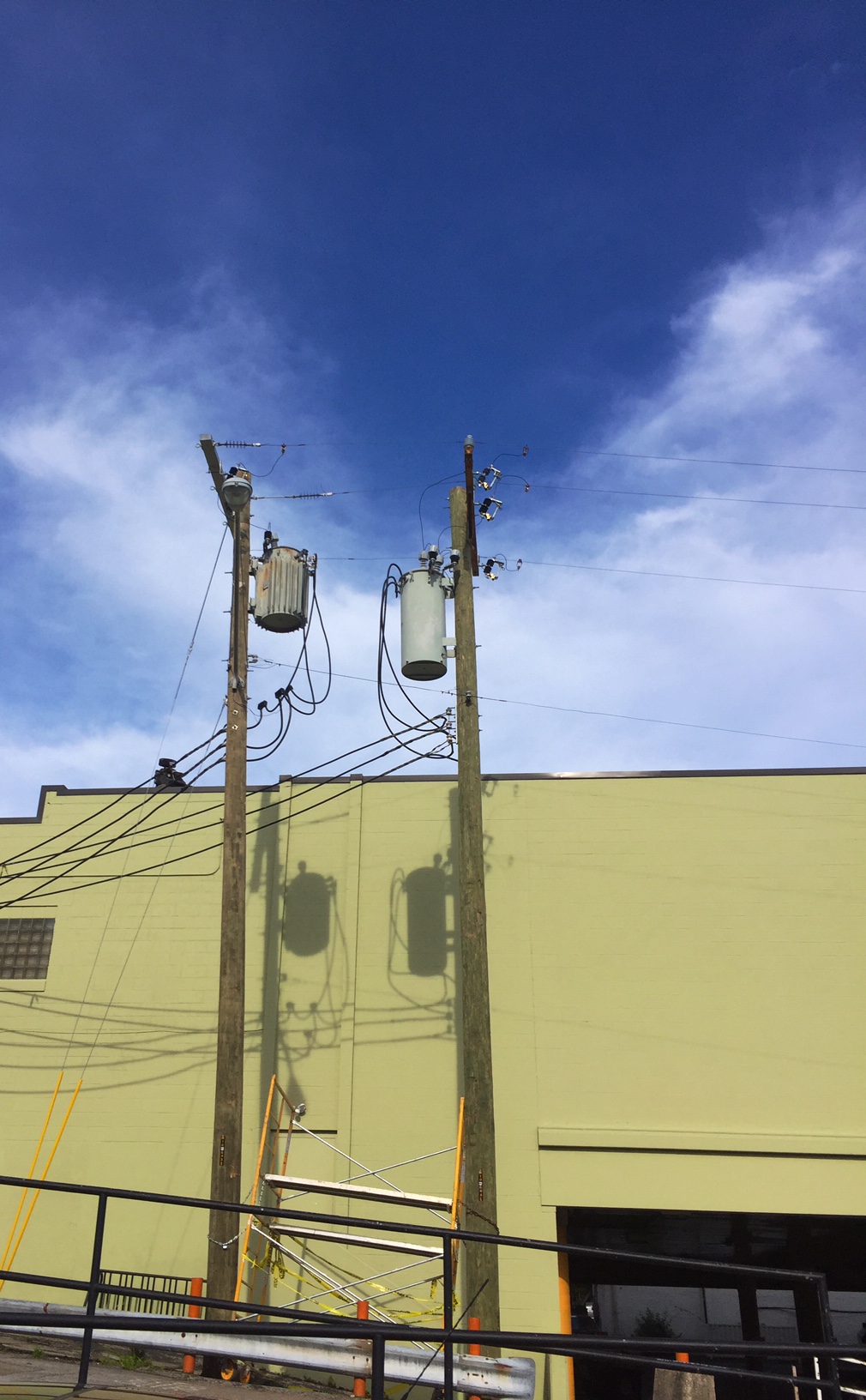

 eeo
eeo 